
This is about social capital and innovation, and what happens when we work from home.
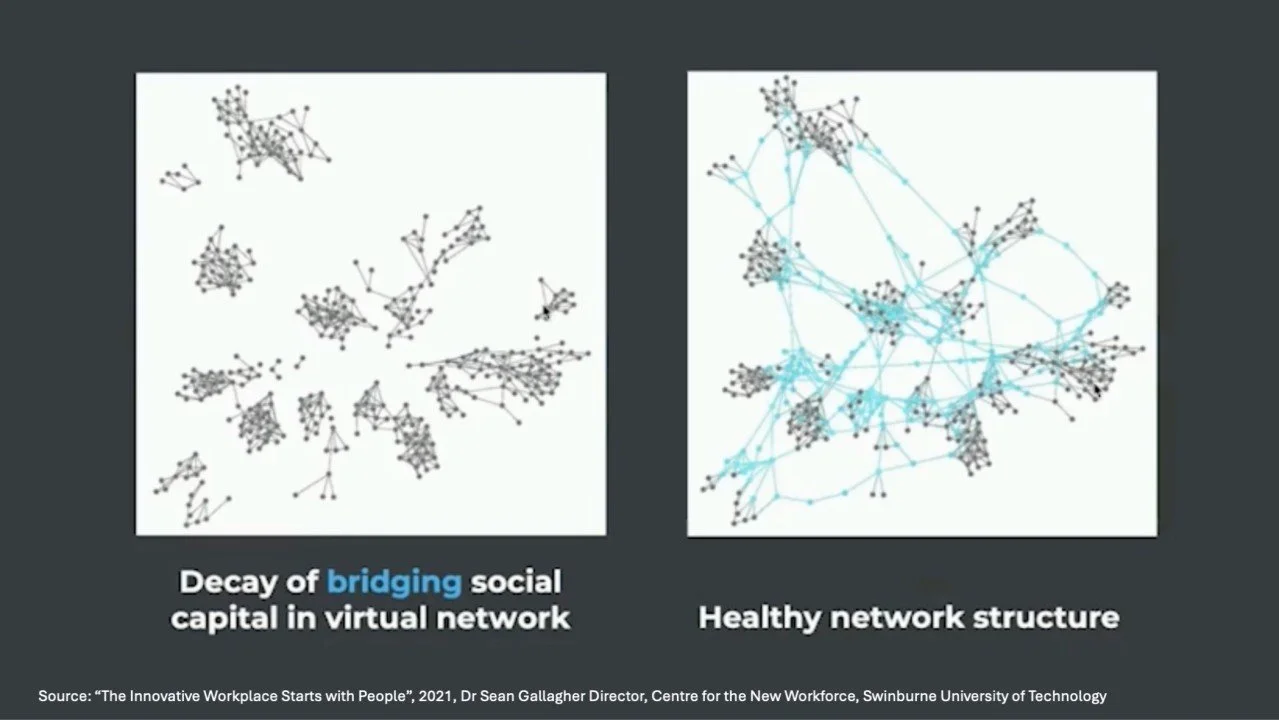
This picture shows two diagrams, taken from a study on 1,000+ workers. Each dot on the diagram represents a person. Each line between them represents a social connection.
Social connections are stronger (dark grey lines) when they are between people who know one another pretty well – they may work together in the same team. They have a high level of familiarity and trust. We call these bonding ties.
Social connections are weaker (blue lines) when they are between people who are familiar with one another, but don’t know each other very well. Maybe they work in the same building and know each other’s names or faces. Maybe they stand in the coffee queue together. Physical proximity is great at building what we call bridging ties.
The diagram on the left shows what happens when people work from home. They are productive within their team, and form strong bonding ties with those they directly collaborate with.
The diagram on the right shows what happens when people share a space. You can see that in addition to the team ties, they have many connections across the organisation. These are bridging ties.
This pattern was observed consistently across the study’s 1000+ participants – it is not anecdotal.
These many weak social ties that bridge are actually a powerful thing.
Many bridging ties = Getting things done, faster.
When there’s a level of familiarity between people it means that when there’s a problem to be solved, an idea to test, or an insight needed, things move faster. You know who to call, you know they’ll pick up the phone or simply be there to tap on the shoulder & help find a solution faster.
Having this diversity of social ties is also good for creativity and innovation.
When people are at least familiar with each other, diverse insights are more easily sourced. Teams who have diversity of experience, expertise and vantage points have been shown to be more innovative. These bridging social ties across an organisation empower this.
Over time this scenario on the right means faster collaborative problem solving, and a higher chance of new ideas finding their way to realisation.
On an individual level it may not feel like it makes a difference, but for an organisation over time, it is very real.
Today, organisations need more than productivity to survive. Increasingly organisations need to innovate to evolve and create new value for customers.
And the physical workplace, as the easiest means to nurture wide networks of diverse social ties, is where this happens. This is why it’s worth investing in the right workplace setup, and hybrid strategy, to get this right.
The ‘how much time in the office’ question matters, but so does the ‘what kinds of spaces’ question. Having people in the office is about finding the right balance between individual flexibility and team and organisational needs. Getting the space right means contrasting private, focused work areas with spaces designed for collaboration, connection and creativity.
(Research source: Dr Sean Gallagher, Centre for the New Workforce, Swinburne University of Technology, Australia)