
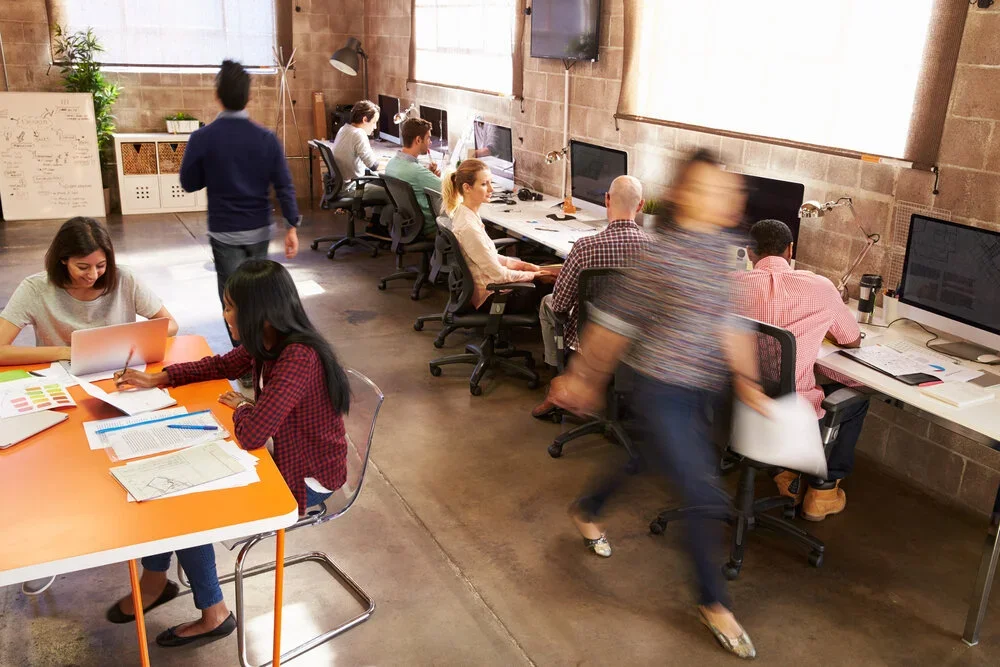
With more and more organisations evolving the way they work to incorporate more flexible work styles, hot desking, also known as unassigned seating, is becoming more and common in the workplace. While hot desking in itself is not a solution, and should be seen as part of a holistic workplace strategy, it’s worth noting some key aspects to get right if you’re going to go down that road.
Hot desking does not mean better productivity
Gensler’s 2020 US Workplace Survey revealed that hot desking is more stressful for employees than assigned seating, and leads to lower productivity and an overall worse workplace experience.
It can be confusing and time consuming having to find a seat every day, and even more distracting trying to get work done when you’ve got new people, settings and noises that you’re not accustomed to going on around you. If you think this is hogwash, try moving your desk a metre away (perhaps the other side of the room or pod) and face the other direction. You’ll see that it takes a little acclimatising to having different people looking over your shoulder.
Daily uncertainty
Not knowing where you’re going to sit each time you come in to the office has a negative impact on employee productivity and experience. Having to acclimatise daily to different surrounds takes up cognitive load, meaning you’re less focused and engaged in your actual work. Consider the effect of this on each employee over a year, and you have a lot of lost productivity.
2. Acoustic and visual privacy
Lack of access to private space is the number one drawback for hot desking, according to Gensler.
With each new desk space comes a micro-environment of acoustic and visual distractions: doors opening and closing, conversations of new voices, clinking of teaspoons or unwrapping of foodstuffs from a nearby kitchenette, and the passers-by in the corner of the eye. Visual screens, acoustic buffers, planted borders and clever space planning can help create some level of acoustic and visual privacy here.
There are distractions you’re exposed to, and then there’s also the fact that you yourself are the distraction. Taking a call and having one’s own private conversations or those concerning more sensitive projects or information, require a level of on-demand privacy that is often not possible in a hot desk setting, which is most often in an open plan environment. Having an easily accessible acoustically private space close to the desk space can help here.
3. Allocated areas for familiarity
Neighbourhood seating, where teams of people are assigned a more permanent hot desking area, provides one route to daily consistency. A team of eight, for example, could be assigned four desks with the rotation set up so that only 50% of them are at these desks at one time, meaning that when they do come in, the surrounding faces are familiar, and are those that they will likely already be working with. Proximity and familiarity make a difference.
4. Wayfinding and people-finding
When you’re in a sea of unassigned seating, how do you find Sbu in Accounting when you need a quick face to face? Is she even in the office? Workspace booking and management software (also known as is a key tool to incorporate when transitioning to more flexible work styles. Software that integrates seamlessly into your employee app, calendars and space monitoring systems can help colleagues find a seat, find each other, and book collaboration spaces comfortably and quickly. These systems are also valuable in monitoring the effectiveness of your space planning and provide valuable data for in ongoing space improvements.
5. Sanitary status
Consider also that in a post-Covid return to work, cleanliness of a workstation, especially one that is shared and thus has a higher utilisation, is going to require more cleaning and maintenance. Consider that from the employee perspective, the communication of the sanitization is as important as the actual act. How do you know a desk has been deep cleaned if you can’t see the cleaner at work? Consider signifiers and communication tools to support this.
Don’t forget to evolve your workspace with your workforce
With a more mobile workforce spending less time in your actual offices, are you creating spaces that actually attract people back to them? Are you creating spaces where people feel they can be truly productive, connect authentically with colleagues and feel a part of your organisation’s bigger purpose?
*
Transitioning to a more flexible way of working can be a fantastic step in the evolution of an organisation, but needs to be planned and managed with care. Contact us to find out we can help you get your workplace working for your business.